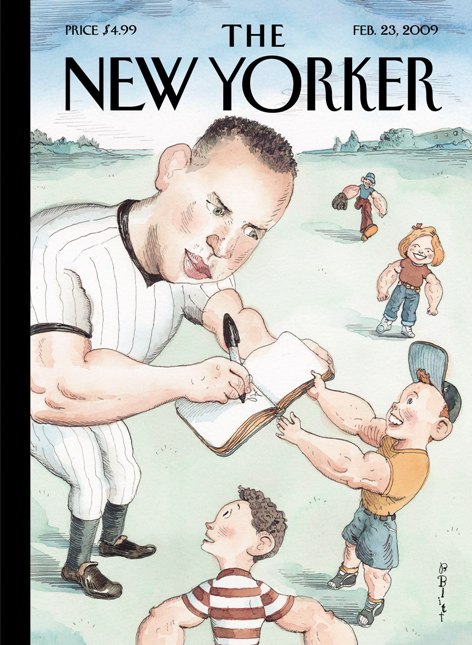
First off, it’s not a doll. It’s an action figure.
Now that that’s out of the way, let’s get on with the business of The New York Times’ recent report that Red Sox sluggers David Ortiz and Manny Ramirez were found to have used performance enhancing drugs (PEDs), according to a 2003 test administered by Major League Baseball.
They weren’t alone. According to The Times’ sources, a perpetually leaking list of over a hundred PED users was compiled in 2003 as a result of a league-wide test. That list, intended to be confidential, now includes Yankees superstar third-baseman (and perpetual media whipping boy) Alex Rodriguez, former home run champion (and pathological liar) Sammy Sosa, and all-time home run king Barry Bonds (also a chronic liar).
Ortiz has been plagued by injuries over the past two seasons and is mired in a season-long hitting slump. Having a rash of career-threatening injuries that ultimately culminates with a significant drop in production and, eventually, early retirement is a hallmark of prolonged steroid use.
(Theoretically, the increased force and torque generated by more powerful muscles creates added stress on joints, tendons, and ligaments, thus leading to a greater likelihood of injury. Another - though not necessarily competing - theory suggests that, when anabolic steroids are used, bones and connective tissues aren’t given the ample time to develop in concert with such rapidly proliferating muscle tissue. In other words, the old frame has issues supporting the new bulk. )
Another thing about Ortiz was that he was a middling player prior to the 2003 season. And that’s being nice. That he was a portly, defensively maladroit designated hitter, with limited power, rendered Big Papi expendable when the normally savvy Minnesota Twins released him following the 2002 campaign.
As you can see here, Ortiz’s hitting stats from 1998 to 2002 were mediocre, at best, although he didn’t technically become a full-time player until ’03. Which brings up the chicken-and-egg conundrum: Did David Ortiz become a full-time player with his new team - the Red Sox - in 2003 due to better performance, or did he perform better because he was finally given ample chance to do so?
(An alternative theory: Ortiz was so intimidated by the city of Boston’s historical “discomfort” with minorities that he was terrified of upsetting his new team’s overzealous, lily-white fan base, which, in turn, brought upon a renewed focus and enhanced work ethic.)
Things get even more dubious when one considers the utter havoc Ortiz wrought upon American League pitchers between 2003 and 2007, each year finishing in the top five of the MVP voting. His stats between those years were Ruthian, and his reputation for hitting in pressure situations became legendary. Statistics also reveal that Ortiz reserved a special place in his heart for pounding Yankee pitchers into a creamy yet savory pinstriped paste. Without mercy, of course.
Did David Ortiz ever make me cry? Yes. On more than one occasion? Yes. Do I hate him for it? Hate is a very strong word. So yes.
But now Ortiz is a known cheater, though he claims otherwise:
''I've just been told that the report is true,'' Ortiz said in a statement after contacting the union. ''Based on the way I lived my life I'm surprised to learn I tested positive.''
Source:
And that, my friends, is called prevarication.
Nevertheless, it’s important to note that Major League Baseball fully implemented its drug policy in the spring of 2006, the year in which Ortiz launched over 54 bombs and OPS’d over 1.000 (A 1.000 OPS is the modern benchmark for truly dominant hitters.) In ’07, Ortiz also achieved an OPS over 1.000, so if he stopped using steroids in ’06 to coincide with the new policy, the residual benefits of them remained significant.
Which makes one wonder if Ortiz could’ve accomplished any of this without using PEDs in the first place. I say this not due to my repulsion of all things Boston but because Ramirez - his teammate for six years on the Sox - has compiled even more astounding statistics throughout the entirety of his career, playing at an MVP level before and since the advent of the official testing policy. The same goes for Alex Rodriguez and could be said about Barry Bonds as well.
It’s been claimed that Manny, A-Rod, Roger Clemens, and Bonds would’ve been all-time greats, irrespective of their PED usage. They were great when they were zygotes. So, the thinking goes, whatever physical benefits they derived from steroids were merely the icing on the cake of their already superhuman DNA. On the other hand, PED users such as Ortiz, Jason Giambi, the now deceased Ken Caminiti (who once claimed that at least half the players during his playing days were juicing), insufferable attention whore Jose Canseco, and Andy Pettite, while exceptionally talented, were never destined for the Hall of Fame. If anything, using PEDs enabled them to creep temporarily into the hallowed pantheon of superstardom, a place already occupied by the likes of contemporaries Ken Griffey Jr., Randy Johnson, Albert Pujols*, and Greg Maddux.
* There have been whispers lately about Pujols - inarguably the greatest player in the game at this moment - possibly making an appearance on The List. I realize it would be devastating from a fan’s standpoint, but would you really be all that surprised at this stage?
Although aren’t we making a huge supposition here - that some of the greatest ballplayers of the modern era - Manny, A-Rod, Bonds, and Clemens - began taking steroids at some point during their respective careers in the Majors? You know - a little something extra to stave off the undesirable physical effects of the dirty thirties and to boost on-field performance in order to get that $100 million free agent contract?
But what if they’d been taking PED’s the whole damn time, throughout the duration of their careers in both the Majors and minor leagues? Hell, who says A-Rod didn’t start popping Dianabol in high school? I mean, granted, the circumference of Barry Bonds’ head expanded three-fold over a five-year span, well after he’d already established himself as one of the game’s premier all-around players. But what of the others? Couldn’t they have conceivably started using in the minor leagues, where attitudes and oversight were even more lax?
If one considers that anabolic steroids have been widely available for consumption in the U.S. since the 1980s, then it’s reasonable to speculate that all of these players had at least the opportunity to ingest steroids throughout their storied careers.
Since we still don’t fully know the extent to which anabolic steroids improve an athlete’s performance, it is reasonable to at least consider the possibility that there are at least a few superstars, past and present, headed to The Hall who owe their entire careers to the juice.
And what about those beloved players from the 80s and 90s, whose career spans fortuitously averted the now infamous 2006 MLB PED dragnet?
Yankee icon Don “Donnie Baseball” Mattingly was never forced to endure scrutiny due to his retirement following the 1995 season. But his playing days coincided with the “live ball” era and his career arc includes two telltale signs of known MLB steroid users: A precipitous rise to superstardom converging with a window of greatness cut short by a rash of muscular-skeletal injuries. Now that Mattingly’s a New York folk hero, it’s blasphemy to even suggest that he could have been in the same building with a vile of Deca-Durabolin (much less injected a syringe full of it in his saintly ass), but the possibility remains for anyone who played at any point over the last 25 years.
And then there’s the melancholic ballad of Nomar Garciaparra, one of the most popular players in Red Sox history. A Rookie Of The Year shortstop in 1997, in which he slugged 30 homers, Garciaparra finished top-ten in the American League MVP voting four years in a row, between 1997 and 2000 - a span in which he was considered arguably the second-best shortstop in all of baseball (right behind A-rod). So what happened?
Injuries. Pulled groins, torn hamstrings, blown-out wrists - injuries that have come to typify steroid use. In 2004, he was traded to the Cubs (If articulated to a Sox fan several years earlier, such a scenario would’ve no doubt produced large quantities of a.) unbridled rage b.) tears c.) Samuel Adams d.) more rage e.) unintelligible mumbling and whimpering, interspersed with an occasional “Why, No-mah - Why?”) Since then, Garciaparra has become a journeyman, bouncing around the league to teams looking for a versatile, part-time veteran presence. Even when healthy, he’s now a shell of his former self.
Once again, the telltale signs: A small window of excellence, coinciding with (in Nomar’s case) an inflated physique, followed by a rash of career-scuttling injuries.
Don’t be mad: They’re baseball players, not gods. They’re buffed-out mini-corporations who have been sheltered from normal society since they were able to pick up a bat. And because humans are perpetually searching for saviors, we deify them. I know I often do.
You do not love these guys. In fact, you probably wouldn’t even want them over for a late lunch and polite conversation. Professional athletes are paid handsomely to be physically dominating specimens. Do you recall, to any degree, the prevailing dispositions of the most physically dominating individuals at your high school or college? Exactly: Total raging douche bags. So don’t magically think that some of these guys are any better just because they get their uniform grimy and run hard down the first base line like they’re supposed to do.
That Mattingly and Garciaparra are purportedly good guys among all the avaricious prima-donna egomaniacs in pro sports doesn’t preclude them from being PED junkies, as evidenced by Andy Pettite’s admission in 2007.
So does any of this really matter? Are there justifiable reasons for fans’ outrage over all this? The answer is, it depends.
If it matters to you that anyone under the age of 25 has probably never seen a Major League baseball game played in which at least some of the players were using either steroids or Human Growth Hormone, then perhaps your outrage is just. Keep in mind, though, that baseball players have been finding new and innovative ways to cheat since Ty Cobb (racist) first conceived of sharpening his spikes to impale opposing infielders with. Then there are the corked bats, spitballs, and sign stealing that have always been emblematic of our National Pastime. And, as recently as 2006, players popped amphetamines (aka “greenies”) like potato chips to stave off the drudgery and physical toll of playing a 162-game season. So it’s possible that your grandpa didn’t even have the luxury of watching a cheater-free game.
If it matters to you that, since the game of baseball is tagged with the honor of being America’s Pastime, it should, to some degree, reflect our nation’s alleged dedication to excellence, hard work, and fair play, then you have a right to be steamed - just as long as you don’t ignore the other virtue the sport holds sacred: greed. The average Major League baseball player makes over $3 million a season, the average teacher approximately $45 thousand.
And if it matters to you that the hallowed statistics and records upon which the game of baseball rests its prodigious foundation have been irrevocably stained by the era of steroid use, then let your outrage be justified. But also understand that many of Babe Ruth’s historic home runs were hit while his body was liquor-soaked, hungover, and/or STD-ravaged.
And these are only the players whose transgressions we know about. No one’s innocent.
And so my advice is to enjoy the games: Appreciate the escapist element with which professional sports provide us. Root for laundry. And, for Yahweh’s sake, don’t look for professional athletes to be your beacon of rectitude. That’s what rappers are for.


 Posts
Posts